Source
Source: Plain-language digest of Identification and Mentoring Gifted Children Age 3–15 Years (with special focus on Maths and Science) (NIAS Report R37-2016), by Anitha Kurup, Jyothi Sarma, Ajith Basu, and Ajay Chandra. Published by the National Institute of Advanced Studies (NIAS), Bengaluru.
Read the report: PDF on NIAS ePrints
Programme home: NIAS — Education for the Gifted and Talented (EGT)
Also see: NIAS-EGT on GiftedKids.in
Further reading: NIAS ePrints record · Agastya International Foundation
GiftedKids.in is not NIAS. We share this research so Indian parents and teachers can use it. Words below are a plain-language digest, not a substitute for the full report.
The problem parents recognise
Many Indian families meet “talent” only through competitive exams: school boards, entrance tests, olympiad pathways, NTSE-style filters. High marks matter—and for some children they are a fair signal.
The NIAS report’s foreword and summary are blunt about a different truth: exam-heavy identification over-rewards children who adapt well to that mode of testing, and can exclude children who are gifted but uncomfortable with—or poorly prepared for—that format.
If a child’s gift shows up as deep curiosity, unusual problem-solving, creative leaps, or rapid grasp outside the syllabus, a timed paper may never see it.
Example (illustrative)
Composite vignette — not a real child from the NIAS report.
Two Class 6 children sit the same unit test. Ananya scores 94% — she has practised the pattern for weeks. Kabir scores 62% — he spent the night inventing a cardboard model of the water cycle after one classroom demo, and ran out of time on the paper. Coaching centres celebrate Ananya. Kabir’s teacher writes “needs focus.” Exam-only talent filters are built for Ananya’s day; they often miss Kabir’s mind.
What national programmes reach—and whom they miss

India already has valuable national efforts in maths and science talent (the report names programmes such as NTSE, KVPY, Maths and Science Olympiads, and INSPIRE). These matter.
But the report notes a structural gap: reach has often skewed toward urban children and, frequently, higher socio-economic strata. Gifted children in rural or less privileged settings remain unidentified—not because the gift is absent, but because the net is too narrow.
For a teacher in a government school or a parent outside metro coaching culture, that sentence is the whole story: the pipeline is not the population.
Example (illustrative)
Composite vignette — not a real child from the NIAS report.
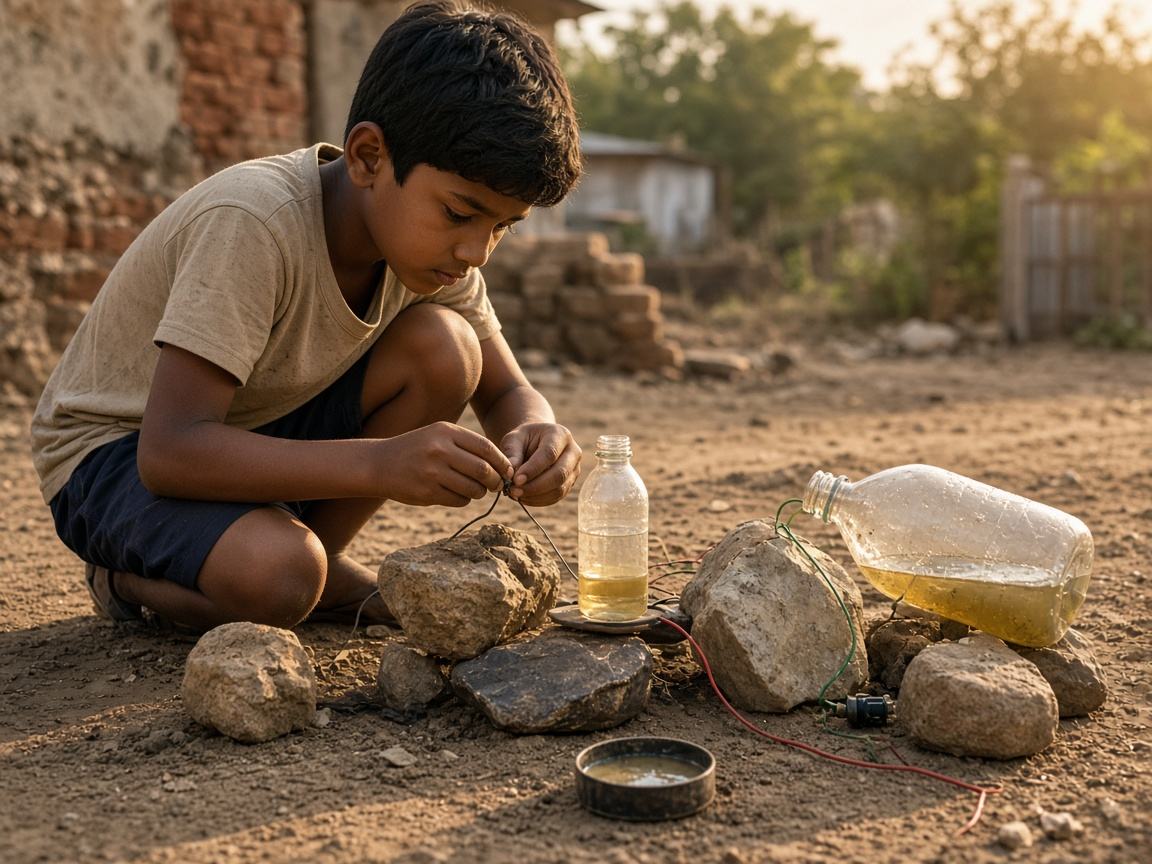
In a small-town government school, Suresh has never heard of NTSE. He fixes the handpump with scrap wire, explains leverage to younger children, and loses marks because English word problems confuse him. No olympiad coach will find him. A nomination-plus-hands-on path — closer to what Agastya and NIAS argued for — is how a child like him enters the conversation at all.
Why Western-only tools are not enough
The project argued that common identification tools—many intelligence and academic tests with Western origins—need careful handling in India’s plural, multilingual, multicultural context. India needs multiple tools, mixing quantitative and qualitative methods, standardised enough to be fair and sensitive to local realities.
That is why the national project did not force one collaborator into one method. NIAS, Delhi University, and Agastya each built models suited to their populations.
What “better identification” looked like in practice
Instead of “one exam day,” the teams leaned on:
- Nominations by teachers, parents, peers, and (in some models) the community or the child
- Classroom and field observation of learning behaviours over time
- Hands-on science and maths tasks (especially in Agastya’s rural pathway)
- Layered screening—wide talent pools first, then sharper selection
- Case profiles that capture development, not only a score
Delhi’s framing is useful for schools: there is no single profile of a gifted learner, and no single criterion is enough.
What you can do this week
Parents
- Notice how your child learns when marks are not on the line.
- Keep examples: questions they ask, projects they finish, books they devour, problems they invent.
- Ask the school what enrichment exists beyond coaching for the next test.
Teachers
- When nominating “bright” students, ask: who shows curiosity, persistence, and transfer—not only top rank?
- Watch children outside the test window: discussions, experiments, peer help, unusual solutions.
- Remember first-generation and rural learners may hide ability behind language or access gaps.